Make Your Mark
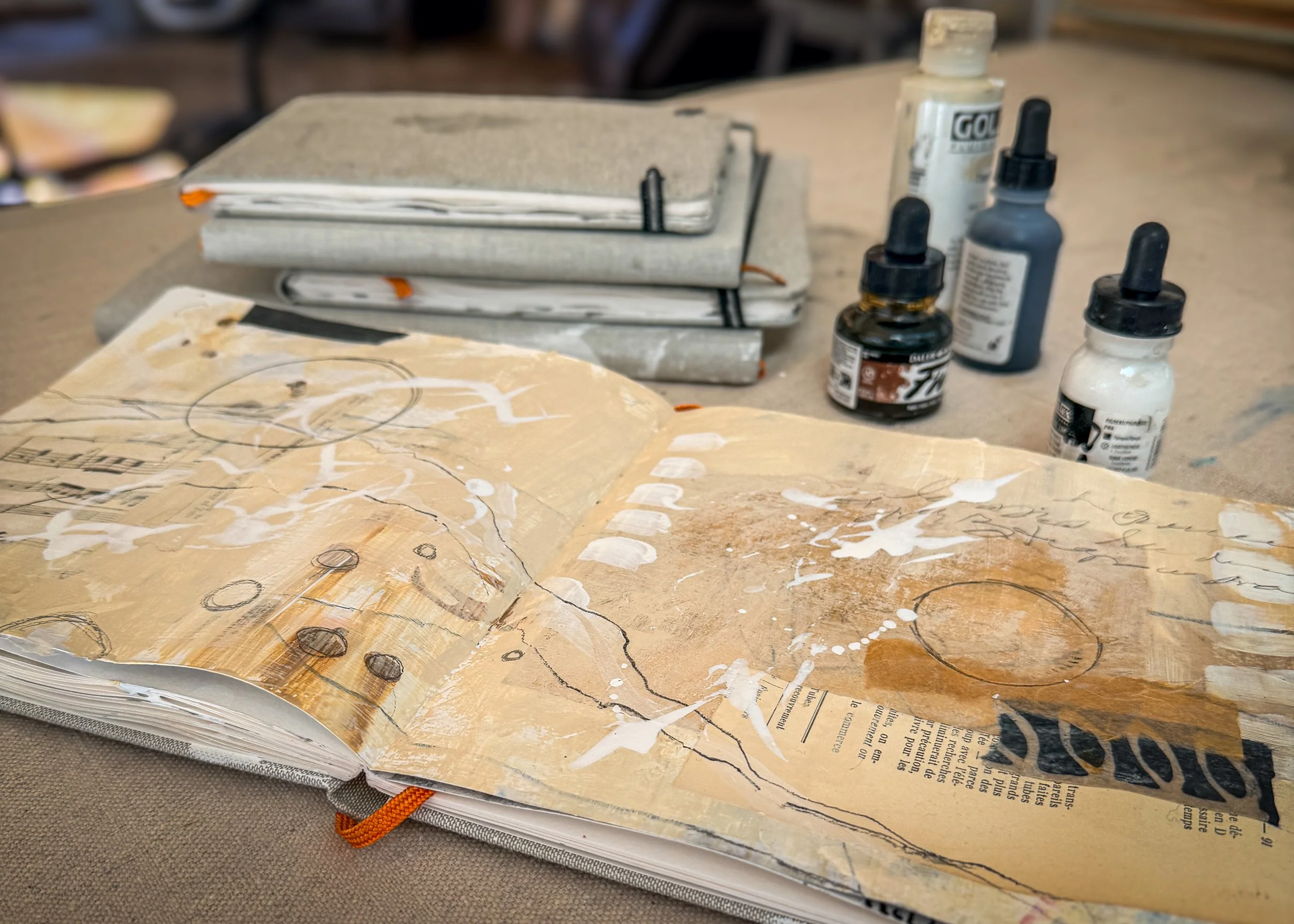
I pull out my favorite Blackwing Matte pencil — the one with the dark, soft graphite and its square eraser. I open to the latest page in my sketchbook and run my hand over the thick, creamy paper.
And I begin.
I don’t have a specific thing I am trying to draw. I am just making marks. Dark graphite on white paper.
Over time I have learned that I have a favorite way of making marks. I like drawing thin, sensitive lines across the page — some wandering, some intersecting. I like layering round, imperfect circles. They make me think of spirals, and sometimes roses. I like making small tick marks — lines and lines of them. Sometimes they are straight and ordered. Sometimes they are irregular and uneven.
This mark-making is, in some ways, just an elevated form of doodling. But it is more than an idle activity. I have come to understand that these gestures are part of my own visual vocabulary. They return to me again and again. They feel familiar in my hand. They carry something of how I see.
And this is the part that surprises people: everyone has marks like this.
Most of us assume that art is about learning to draw something correctly. We imagine that skill precedes expression. But long before we learn to render a form, we are already making marks. As children, we loop and press and scratch across paper without self-consciousness. We are not trying to impress anyone. We are simply exploring.
Somewhere along the way, many of us stop trusting those early instincts.
But your hand remembers.
If you sit with a page long enough — without agenda, without expectation — you will begin to notice patterns. The shapes you repeat. The pressure you apply. The rhythms you create. These are not accidents. They are clues.
Your personal marks are not meant to look like mine. They may be bold and angular. Or soft and broken. You may favor blocks of shadow, or delicate threads of line. You may fill the page. You may leave vast spaces empty.
None of this is trivial.
These marks form the beginnings of a visual language — one that belongs only to you. A language that reveals how you move through the world. A language that cannot be borrowed.
When we honor our own marks, we stop striving for someone else’s style. We begin to work from the inside out. The process becomes less about producing a beautiful object and more about discovering how we see.
It starts simply.
A pencil.
A page.
A mark.
And then another.